
Technical Hub
Yield comparison of chicory grown on five Waikato dairy farms
Introduction
Chicory has become a popular forage crop for dairy farmers due to its high expected yield and nutritional benefits for livestock over the summer months. Outside of being part of a pasture renewal program, farmers have opted to grow chicory to supply quality feed (energy and protein) during the summer months when pasture yield and quality is expected to decline on most dairy farms. However, there is little information available to quantify the drymatter yield of pure chicory swards vs pasture when included in a grazed farm system. Given the costs associated with establishing chicory, and that farmers ideally require a minimum of 10% of the farm area in chicory to supply >3kg DM/cow, it is important to know whether chicory is yielding as expected and improving farm productivity.
The objective of this trial was to determine chicory and pasture yields from October to May in dairy systems and to consider the cropping costs against alternative options to supply summer feed.
Method
The study was conducted during the 2022-23 and 2023-24 seasons on five commercial dairy farms between Hamilton and Te Awamutu in the Waikato. The farms varied in scale, system intensity and proportion of chicory inclusion (Table 1).
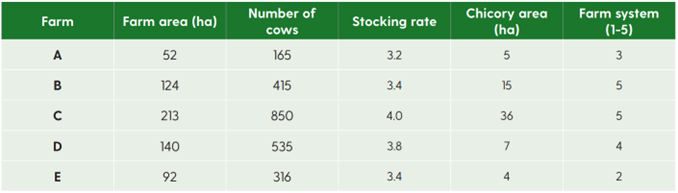
Chicory crops were established between the 28th September and 20th October and sprayed out between the 12th March and 19th April of the following year before pasture renewal. Chicory was primarily strip grazed 3-6 times between December and April, providing 1 to 3 kg DM of the daily dairy cow diet during the summer period.
In spring, designated chicory paddocks were sprayed out, and five herbage cages (1 m2) were placed onto the chicory paddocks after they were sown. Five herbage cages were placed on an adjacent permanent pasture paddock that represented average pasture production on the farm. These cages prevented dairy cows from grazing, allowing for the assessment of drymatter production without animal interference. After each grazing event of the pasture paddocks, the vegetation under each cage was mown to a height of 4 cm using a standard lawnmower. Once the chicory paddocks were established and had grown sufficiently to be grazed (December-April), the same measurement method was applied.
Cut grass and chicory were collected and weighed to determine the fresh weight. A subsample was submitted to a commercial laboratory for drymatter assessment. After samples were collected, cages were moved onto the grazed area so regrowth was representative of the grazed area.
Chicory cuts finished when the paddock was sprayed out. Pasture cage cuts were taken at every grazing event until 1st May, when the chicory paddocks returned to the grazing rotation.
Results
During the 2022/23 summer, January-March rainfall was 369 mm (Waikato Regional Council environmental data hub), 185% of the long-term average (199mm). In the 2023/24 summer, Jan-Mar rainfall dropped back to 219 mm, 110% of the long-term average. Consequently, monthly pasture growth rates (Jan-Mar) for the 2022/23 and 2023/24 seasons were consistently higher than the expected average (based on pasture growth rate data from nearby Owl Farm).
Growth rates
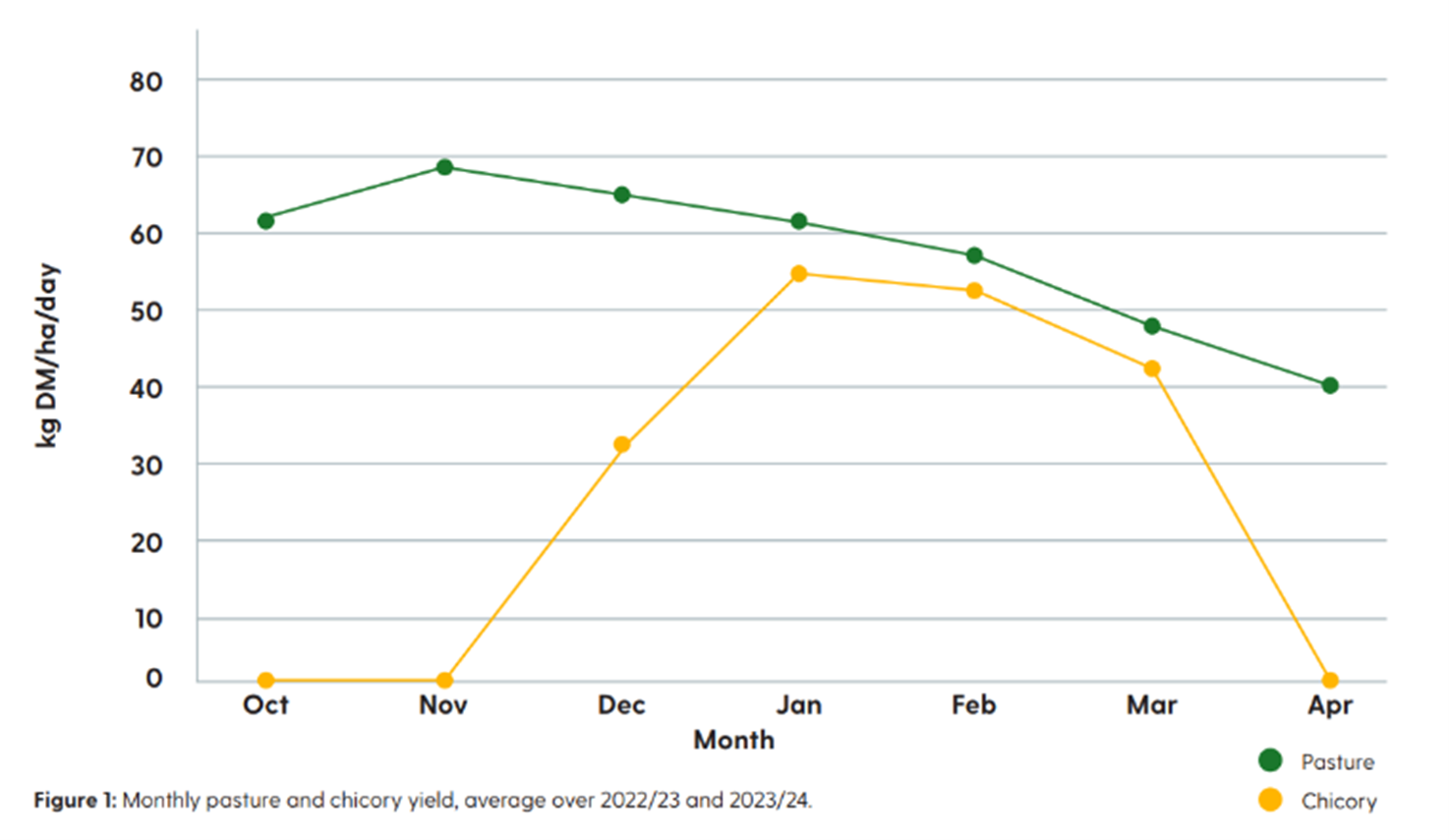
On average, the chicory area produced substantially less yield than perennial ryegrass during the establishment phase from October to December and a similar yield from January to March (Figure 1).
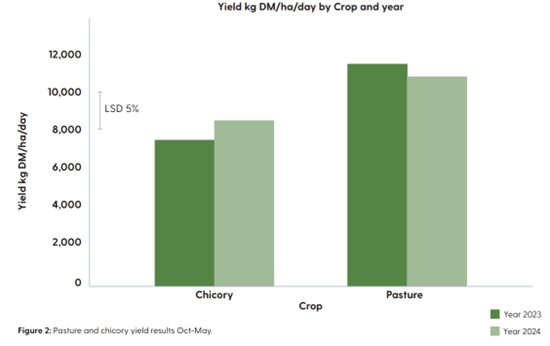
Over the two years of the trial, chicory produced an average of 6,771 kg DM/ha, while perennial ryegrass yielded an average of 11,508 kg DM/ha, meaning that chicory yielded around 4,700 kg DM/ha less than pasture per year (Figure 2).
Financial
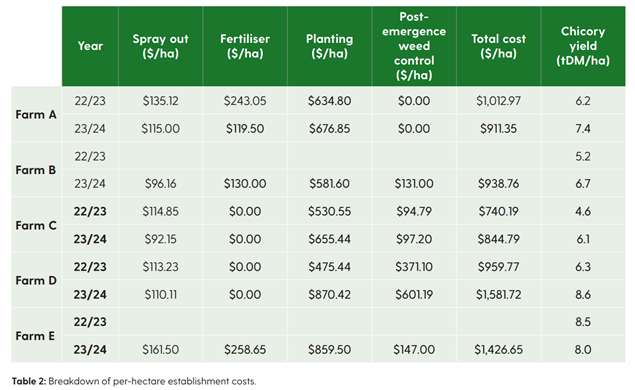
Over the two years of the trial, the average on-farm establishment cost for chicory was $1,052/ ha and ranged between $740-$1,582/ha (Table 2). The most notable drivers behind the wide range in establishment costs were whether starter fertiliser was applied, the post-emergent weed control program and in the case of Farm D, having to replant the chicory crop due to failed germination.
Discussion and conclusions
Farmers reasons for growing chicory include managing spring pasture surpluses, feeding youngstock, improving summer feed quantity and quality, weed control and assisting with pasture renewal.
During the two trial seasons, growing chicory shifted a surplus of feed from spring to summer/autumn but did not increase total drymatter production above that achieved from a well-managed ryegrass-clover pasture.
Long-term average pasture analysis data collected from ten Waikato dairy farms between January and March over 12 seasons shows an average energy content of 11.2 MJ/kgDM and crude protein of 24.8% (pers comm. Tim Sandbrook, Open Country Dairy). While this is slightly less energy (12.5 MJ/kgDM) and more protein (20.6%) than previously measured in chicory, it is still sufficient to support mid-to-late lactation milk production.
When the opportunity cost of lost pasture production was considered, chicory became uneconomic because it produced less drymatter than the pasture. When considering feed quantity, quality and establishment costs over the two years of the trial, farmers would have been better off to use the money invested in chicory to purchase a high-quality protein concentrate (e.g., dried distiller’s grain) to provide additional energy and protein if required. Imported feed is more flexible and could be used when needed, at the required rates to strategically fill feed gaps without displacing pasture production.
The improvement in pasture production as a flow-on effect from growing a chicory crop was not included in the scope of this trial. If pastures had “run out” and were more than 40% below full production, then growing chicory followed by sowing new pasture would have a more positive impact on profitability, but would need to be balanced against alternative methods of pasture renewal. To ensure the best chance of a higher-yielding chicory crop, establishment costs should not be skimped.
Based on this analysis, for chicory to be an economically viable crop, farmers would have to have experienced a 30% reduction in pasture production (Oct-May) and a 30% lift in chicory production. This is a significant yield gap to bridge.
1 Bell, W.; Journeaux, P. 2024. Yield and economic value of chicory grown on five Waikato dairy farms. Proceedings of the Australasian Dairy Science Symposium 2024