
Technical Hub
Forage Sorghum X Sudan grass
Product description
Bettagraze is a tall, late flowering, late maturing hybrid (sorghum x sudan grass hybrid) grown for, high yielding summer feed for grazing in dairy, beef and sheep systems.
Rapid early growth, quick recovery after grazing or cutting along with delayed flowering, means Bettagraze is a versatile, easy to manage summer feed. It has a high sugar content, fine stems and a high leaf-to-stem ratio for excellent palatability and good feed value.
Bettagraze requires a minimum soil temperature of 18 °C for quick germination and establishment. Generally, sowing is not recommended before late November – early December.
Site selection
Bettagraze prefers a deep soil with good moisture holding capacity and a medium to high fertility status. The crop fits well into a pasture renewal programme. Forage sorghum and sudan grass hybrids may be susceptible to herbicide residues. Check with your local Pioneer Representative before establishing crops in paddocks which have been recently sprayed with products other than glyphosate.
Soil fertility
Bettagraze crops grown in high fertility dairy farm paddocks (including those with a history of effluent application) may not require any fertiliser. A soil test is always recommended to identify nutrient status and any possible deficiencies. The levels of P and N are important, and a specific fertiliser recommendation should be obtained from your local merchant, fertiliser representative or Pioneer representative, based on the results of the soil test and the requirements of the crop. Remember excessive nitrogen applications (including effluent) can increase the risk of high crop nitrate levels.
Ground preperation
Effective weed control is important for Bettagraze establishment and yield. Currently there are no post-emergence herbicides registered for sorghum in New Zealand therefore it is critical to (1) ensure the seed bed is weed-free and (2) to plant when the soil temperatures are high enough to ensure rapid Bettagraze growth. Pasture should be sprayed-out with glyphosate and then grazed hard three to five days later. The ground should be ready for cultivation 7 - 14 days after spraying. A fine and firm seedbed is essential to promote establishment and weed control.
Sowing date
Bettagraze should be sown 35 - 45 days before it is required for silage or grazing, although not before the soil temperature, at 5 cm depth, reaches 18 °C and is rising. In most areas and seasons this temperature will not be reached until November or December. Bettagraze is an excellent crop to follow cereal silage or a late pasture silage cut in mid to late November.
Bettagraze should be drilled and rolled into a fine moist seedbed at 25 - 45 kg/ha to a depth of 3 - 5 cm. Crops planted at higher rates will have thinner stems and a higher yield potential. Broadcast sowing is not recommended.
Timing of utilisation
Bettagraze can be grazed or cut. Feed quality will be maximised when the crop reaches around 1 metre in height. Although Bettagraze is a late flowering plant, and has better mature leaf retention than other sorghums, it will become rank and lose quality if left too late before grazing or cutting.
Grazing
Bettagraze should be grazed by break feeding to stock. Back fencing is essential to minimise plant damage and allow quick re-growth in the grazed portion of the crop and to avoid crop toxicity. For maximum re-growth potential aim to leave a grazing residual of 15 cm. The crop can be recut or grazed after 4 - 5 weeks when it is at least 0.8 m and no more than 1.2 m in height.
Feed value
The drymatter content of Bettagraze that is 0.8 - 1.0m in height is typically between 13 - 17% DM with 15% being a good average figure to use to determine cow crop allowance. Forage sorghum and sudan-grass products are bulk feeds with an average energy content of 9.0-10.0 MJME/kgDM depending on crop maturity at harvest time. A well-established crop that is between 0.8-1.0m in height will have a drymatter yield of 3.5 - 4.5 tDM/ha per cut.
Silage
Bettagraze can be made into pit, bunker or round bale silage. It is always recommended to cut using a mower-conditioner and wilt in the paddock for a maximum of 48 hours. Bettagraze can be made into hay although it must be planted at high populations to ensure thin stems which will dry more quickly.
Horses
Forage sorghum and sudan grass hybrids can cause major health problems for horses. They should not be grazed by horses or fed to them as hay or silage.
Autumn management
Frosted Bettagraze can be toxic. Always spray out Bettagraze crops before autumn frosts and/or regrassing.
Nitrates
Any crop that grows rapidly has the potential to accumulate nitrates. Nitrate levels are higher in rapidly growing Bettagraze crops that have been planted in high fertility paddocks. Nitrate levels also rise in crops that have been drought stressed or frosted. Bettagraze should always be sampled and analysed for nitrate before grazing/cutting. If you suspect nitrate poisoning, contact your veterinarian immediately.
Prussic acid
Bettagraze, like all sorghums, can release the toxic compound hydrogen cyanide (HCN) causing prussic acid poisoning. Prussic acid poisoning is rare in New Zealand. Sorghum is always low in sulphur and feeding sulphur will reduce the risk of prussic acid problems. Aim for a dietary sulphur level of 0.2%. Supplementation of sulphur is recommended if the pasture sulphur is low (less than 0.25%) and/or you are feeding more than 50% of the diet as Bettagraze To supplement sulphur feed 40 grams of either zinc sulphate or magnesium sulphate per cow per day.
Factors which increase the level of prussic acid include:
Young plants: Avoid grazing crops under 0.8 m high.
Drought: Severe moisture stress.
Frost: Levels rise after light frosts. If crop is killed by frost, wait 5 days to graze.
Nitrogen: High available soil nitrogen may lead to higher levels, as does large amounts applied.
Low phosphorus: Inadequate or deficient soil phosphorus.
Re-growth: Cutting or grazing is a stress on plants, wait until plants are at least 80 cm high.
Herbicides: Applying 2,4-D may raise HCN level.
There is currently no acceptable method for testing for prussic acid in New Zealand. If you suspect that your crop has high levels of prussic acid, talk to your local veterinarian or local Pioneer representative before feeding it (Table 1).
Bettagraze economics
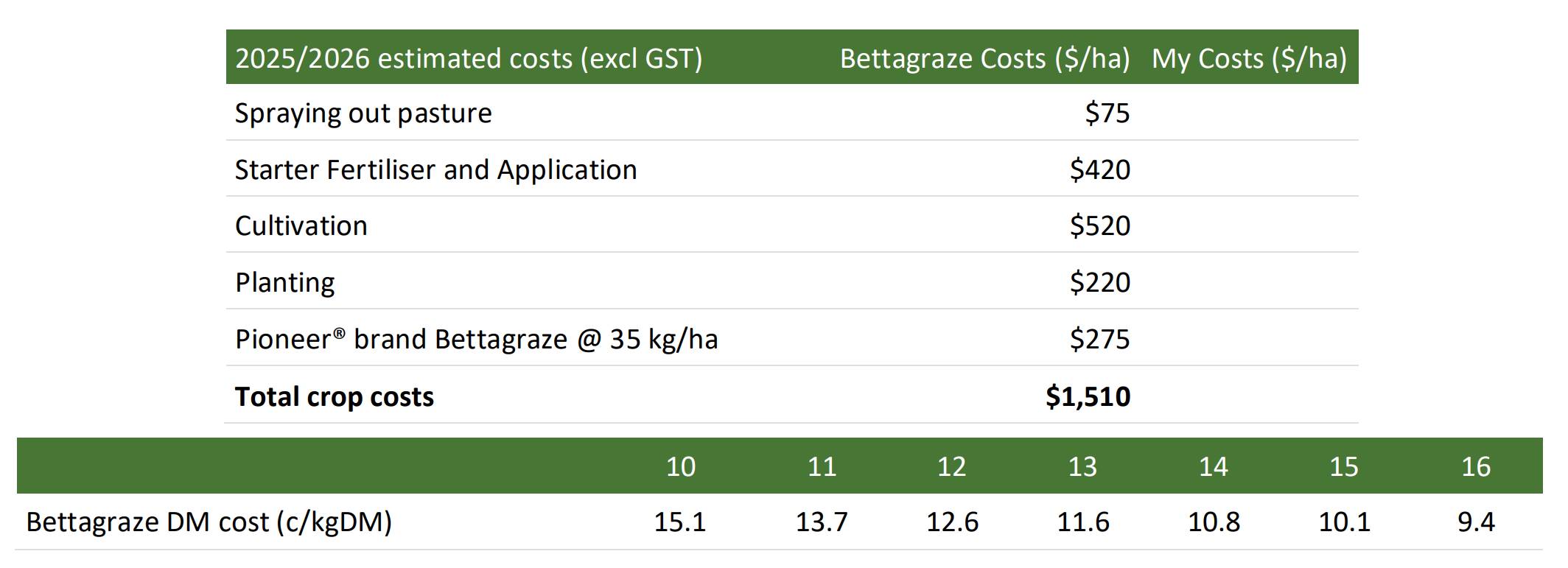
The table below gives the estimated growing costs ($/ha) for Bettagraze.
All costs are estimates only.
The costs and benefits of regrassing have not been included.
For more infomation contact your local Pioneer rep